
Ingalls Building - Cincinnati, Ohio
The first reinforced concrete high rise building ever constructed, the Ingalls Building accounted for about one-half of one percent of all the cement used in the United States in 1902 to 1903.
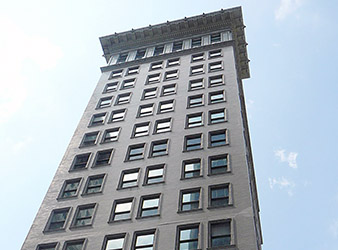
Ingalls Building - Cincinnati, Ohio
The first reinforced concrete high rise building ever constructed, the Ingalls Building was declared a National Historical Civil Engineering Landmark in 1974 and was added to the National Register of Historic Places in 1975.
The First Reinforced Concrete High Rise Building, 1902
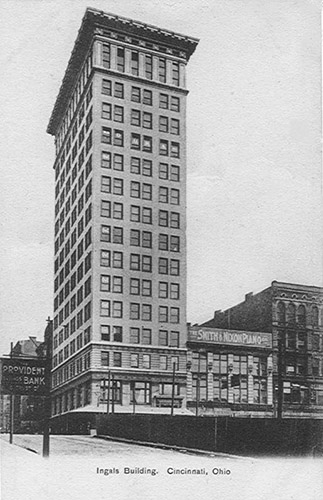
Before the construction of Cincinnati, Ohio's Ingalls Building, the tallest reinforced concrete building was a mere six stories in height. This made the use of reinforced concrete for a 210 foot tall building a controversial decision in 1902. The architect for the Ingalls project, W.P. Anderson of Anderson and Eizner, decided to go with concrete construction despite the fact that detractors feared a concrete building would not be able to withstand wind and concrete shrinkage. Legend has it that people were so sure the building would collapse that a local reporter once stayed all night outside the building, waiting for it to fall down.
Before the first bucket of concrete was poured, a major battle took place just to get the necessary permits to build the structure. Melville E. Ingalls, president of the Big Four Railroad and the building's namesake, and Anderson fought for two years with Cincinnati's building department before finally convincing them of the building's stability and durability.
Anderson chose concrete because it was fireproof and it would be less expensive to build a structure of this size with concrete than with steel. Henry N. Hooper of The Ferro-Concrete Construction Company in Cincinnati was the concrete contractor chosen to carry out Anderson's vision. Hooper employed methods perfected and patented by Ernest L. Ransome, the man who had designed and built the world's first reinforced concrete bridge, Alvord Lake Bridge, in San Francisco's Golden Gate Park in 1889.
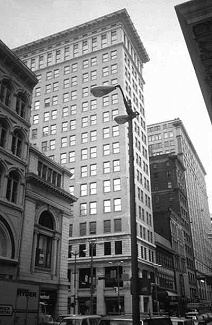
The Ingalls is a massive structure, consisting of solid columns and foundations reinforced with the square-twisted steel bars that Ransome patented. According to the American Portland Cement Manufacturers Association, the Ingalls Building accounted for about one-half of one percent of all the cement used in the United States in 1902 to 1903.
During construction, one hundred cubic yards of concrete were produced on each 10-hour shift. While that was below capacity, it was all the workers could handle in that time period. The concrete had to be wet enough to ensure that spaces around the reinforcements could be filled and the columns would have uniform density around the reinforcements. The concrete contractor also cast beams and girders monolithically with floor slabs, which acted as a diaphragm to deal with the force of the high winds.
Rising at a rate of three stories per month, the Ingalls was completed in just eight months and has been in constant use ever since. It was the tallest reinforced concrete building in the world until the 281-foot tall Medical Arts Building in Dallas, Texas was built in 1923.
The Ingalls Building was declared a National Historical Civil Engineering Landmark in 1974 and was added to the National Register of Historic Places in 1975.