
Grand Coulee Dam - Washington State
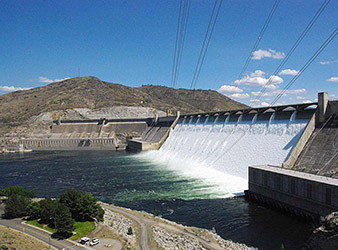
The largest concrete structure in the United States, completed in 1951.
Grand Coulee Dam - Washington State
The finished Grand Coulee Dam is 4,173 feet long and 168 feet high. Concrete contractors supplied a total of 12 million cubic yards of concrete to the project, making Grand Coulee Dam the largest concrete structure in the United States.
America's Largest Concrete Dam, 1933 - 1951
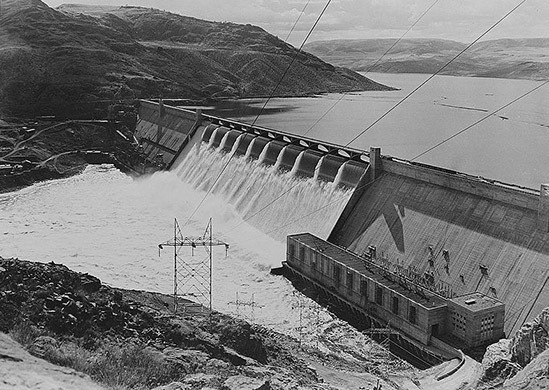
The general idea for damming the Columbia River in order to provide Central Washington with irrigation water was proposed in one form or another since 1904. In spite of this the project was never pursued until Ephrata attorney William M. Clapp proposed damming the Columbia below the Grand Coulee in 1917. State government, prompted by much local interest, agreed to the plan and carried out feasibility studies throughout the 1920s. The Corp of Engineers favored the plan as well, and recommended it to Congress in late 1931. The state of Washington committed $377,000 to the project; the remainder of the $63 million cost was subsidized by President Franklin D. Roosevelt's Public Works Administration.
Original plans called for a low dam for two reasons. First, a high dam is used to generate electricity, and there was no need for additional electrical power in the Northwest. In fact, the region already had a surplus of existing power. And second, because the dam would be built near the Canadian border, there were height restrictions involved. The main purpose of the dam was to be irrigation and flood control, so a high dam was not needed. But the designers were forward thinking. They realized that there might be a need for power in the future and so they designed the dam such that it could be raised to full height if the need ever arose.
Excavation of the dam site began in December, 1933. On August 30, 1935, Congress approved the building of the full height dam and it was completed by 1941, with only construction of the pumping plant and powerhouses remaining. The foresight by the designers and the Congress to build a full height dam later paid big dividends. When America entered World War II, the Northwest had to step up its aluminum production and the extra power generated by the dam was essential to supporting the country's war effort.
When the war was over and the extra power was no longer needed, the dam could be used for the irrigation it was originally intended for. Construction companies began working on the dam again in 1946 and by 1951 it was ready. The finished Grand Coulee Dam was 4,173 feet long and 168 feet high. Concrete contractors supplied a total of 12 million cubic yards of concrete to the project, making Grand Coulee Dam the largest concrete structure in the United States.