
Hoover Dam - Colorado River Black Canyon
Named a National Historic Landmark, and one of the American Society of Civil Engineers' Seven Modern Civil Engineering Wonders.
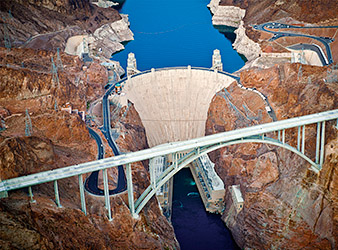
Hoover Dam - Colorado River Black Canyon
Concrete contractors used some 3.3 million cubic yards of concrete in the making of Hoover Dam and another million cubic yards for the power plant and support structures. This was enough concrete to build a two-lane highway from Seattle, Washington to Miami, Florida.
America's First Major Dam, 1936
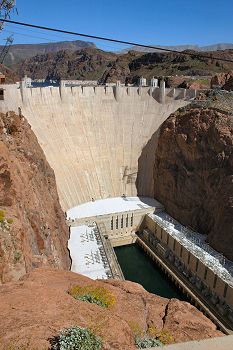
Regaled as an architectural and engineering marvel, Hoover Dam was built in five years-two years under schedule-at the cost of $48.9 million. It stands 726 feet tall and 1,244 feet in length. The base is 660 feet thick, 60 feet more than the length of two football fields, and the top is 45 feet thick. At the base of the dam lay 230 blocks of concrete, each one standing five feet high and ranging in width from 25 square feet to 60 square feet.
Before concrete contractors could even get to work constructing the dam, however, the enormous task of diverting the Colorado River had to be accomplished. In order to do that, four diversion tunnels totaling 16,000 feet were cut into Black Canyon and lined with concrete, a project that in itself took a full year. While water from the river was diverted through these tunnels, suspended high scalers worked on the walls of the canyon to ensure that they were smooth enough to allow proper adherence of the dam's walls, and work crews dredged the canyon's floor down to bedrock.
On June 6, 1933, concrete contractors made history by pouring the first bucket of concrete on the Hoover Dam. Contractors produced the mix onsite in two batch plants, transported to the dam by railroad cars, and poured by an overhead bucket system. This system was able to deliver one bucket of concrete every 78 seconds. The size and nature of the project presented a unique problem, however. Regardless how fast the concrete was poured, contractors realized that by using traditional processes, it would take 100 years for the dam's concrete to cool and cure. And once it did cool, the concrete would crack, rendering the dam useless.
The situation required innovations to expedite the curing process. The contractors imbedded more than 582 miles of one-inch steel pipe throughout the concrete, pipe that carried river water and ice water to cool down the concrete. The refrigeration plant built onsite to carry out this feat had the capability of producing a 1000-pound block of ice daily. When the concrete was set into place and the pipes were no longer needed, they were filled in with concrete to add extra strength to the dam. In this way, the dam was poured into separate interlocking blocks.
In August of 1933, two of the diversionary tunnels were filled in, and in 1935 steel grates weighing 1000 tons were placed over the remaining two tunnels to begin channeling the Colorado River towards the dam.
All in all, concrete contractors used some 3.3 million cubic yards of concrete in the making of Hoover Dam and another million cubic yards for the power plant and support structures. This was enough cement to build a two-lane highway from Seattle, Washington to Miami, Florida.
Thanks in large part to the concrete contractors who worked on it, Hoover Dam was completed in 1935, began power generation in 1936, and the last turbine went on line in 1961. It was named a National Historic Landmark, and the American Society of Civil Engineers named it one of America's Seven Modern Civil Engineering Wonders.